

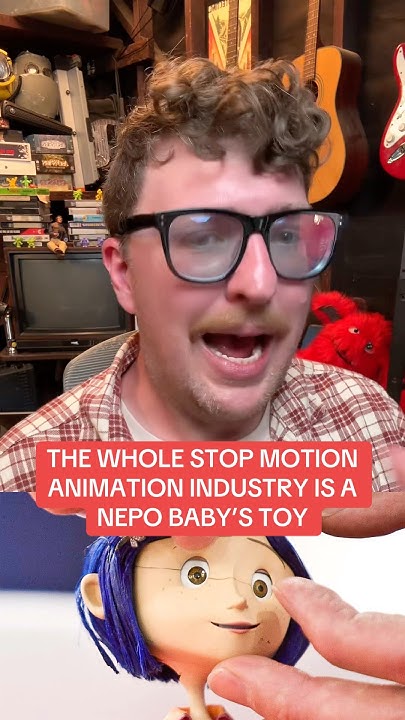
Basically, the only modern studio consistently putting out stop motion animation movies, is Laika Studios. And yet, Laika has only had one financially successful movie, Coraline from 2009, while all their other movies have under performed.
However, Laika is currently led and owned by Travis Knight, son of Phil Knight, the owner of Nike. This has enabled Knight to continually bank roll Laika whenever they under perform, essentially making the entire stop motion animation film industry a nepo baby’s pet project.
That being said, this is actually a positive story, and reminiscent of how artists previously would be financially supported by wealthy benefactors.
I don’t know if motion animation is the same as other types of films, but for most of the industry you need box office sales to be double of the film budget for it to be considered profitable. Mainly due to marketing budgets and the huge percentage of profit that theaters get for the first few weeks of a film’s release.
It’s pretty different from live action according to creators and producers, it’s such a small market and stop motion is so difficult to explain and get off the ground and promote that financial expectations are much more realistic.
You’re right that if a live-action movie costs $100 million to make grosses $180 million, the producers are upset, but that’s a greedy, ego-driven convention of the modern studio system, they are still making tens of millions of dollars before everything on the back end is added in.
The stop-motion world has a more realistic perspective on production and the artists love every single piece of art they create, so also making $40 million as evidence that their art style can succeed in mainstream culture is the cherry on top of any project that even gets to be fully produced.
It’s more that if a movie costs $100 million to make, it’s usually $100 million in marketing. So it would need to make $200 million to break even. Making $180 million means someone lost $20 million dollars, so I wouldn’t really call it greedy. If the movies are not making the money then they’d need to just start reducing scope or just hope someone will keep bank rolling them.
That’s what studios publicly lament about without going into detail. Between streaming, retail and merchandising alone, they’re making their money back.
Marketing campaigns are not bankrupting movie profits.
If a studio makes 180 box office on a 100 million dollar production and they say they’ve lost 80 mil through marketing, they are pulling your leg.
“ah yeah, first quarter my team only made 23 points, oh well, thats the game.”
No, there are three other quarters that the studio isn’t talking about because it reduces their future negotiating leverage.
Of course studios want more money, but studios aren’t losing money on movies that get close but don’t tip the magic number of “double the budget”
If you want to count a whole year, then yes it can technically be made up by other movies down the line for the whole studio, but it won’t change the fact that the movie would have been a failure, that’s how budgets work. The same goes for pretty much any business that has projects or quarters.
They aren’t talking about it being made to by other movies, they’re saying the movie continues to make money for a long time after it’s first week. To give a famous example: in the 90s the Kevin Costner movie Waterworld was declared to be a massive financial flop based on its first week(s) performance in US cinemas, but once you account for worldwide figures and VHS sales it was actually one of the most profitable movies of the decade.
That is very true, but won’t that happen way after the release? That’s usually when these headlines happen.
no, classifying a picture that makes an $80 million dollar profit as a “failure” is factually incorrect, albeit a useful tactic for studios and headline writers.
making an 80% profit is a success in any business, and a triumph in most businesses; that’s how budgets wotk.
i want to note for the nonfinancial types: that’s profit, not revenue. profit is what you have left of your revenues after your costs.
Any picture that makes any profit (and that profit can be someone buying you tacos once because they liked your film on youtube, so long as they’ve bought you enough tacos) is a success.

Hell, any film that gets a screening outside the filmmakers’ social circles is a success. That means someone liked it enough to share it. Have I moved the goalposts enough that I can consider myself a film success because I do, I’m just playing badminton rather than football.
This is backwards. Theaters actually get very little percentage early on in the release and only get more later. Most early profits go to the film studio/publisher. Or at least this was how it worked ore-Covid. Maybe it’s different now.
And to explain your comment a bit more, the production budget doesn’t include the very real costs of marketing, distribution, and any back-end royalties calculated from the gross. Plus generally speaking, the movie is financed by lenders and production companies that will need to be repaid with interest, too.
If you’ve got a $50 million movie and you spend $10 million on marketing/distribution and promised 10% of the gross to people, and the theaters are keeping 10% of the gross, getting a $75 million box office breaks even ($7.5 million to royalties, $7.5 million to theaters, $10 million to marketing/distribution). And that’s assuming nothing lost to interest/financing/inflation.
Side note: generally, theaters don’t get much in the first few weeks. It’s only when a movie shows longer than 3 weeks that the theater starts getting a bigger and bigger cut of the gross.
I would have to think no stop motion film is spending anything near that much on marketing. I’ve never even heard of a few of these. That double rule seems more applicable to big summer blockbusters.